The industry’s own numbers
U.S. laser vision-correction volume crashed 52% in four years.
STAAR Surgical says U.S. laser procedure volume fell for four consecutive years, each with a double-digit loss. Its index drops from 100 in 2022 to 48 in 2026.
STAAR labels 2026 “LE” (latest estimate). The company report provides indexed values, not raw procedure counts or its calculation method, and groups LASIK with other laser vision-correction procedures.
54%
of U.S. respondents were not open to laser correction.
In STAAR’s August 2025 survey of 1,800 U.S. glasses or contact-lens wearers, only 38% expressed interest in laser correction and 51% cited safety concerns.
16.1%
of LASIK eyes had dry-eye disease documented.
The national IRIS Registry study followed 48,892 LASIK and PRK eyes for one year. Diagnostic coding cannot establish that every case was newly caused by surgery.
10.5%
incidence of neuropathic corneal pain after LASIK.
This came from a prospective 100-eye LASIK/SMILE cohort. It is a serious signal from a small study, not a population-wide estimate.
Sources: STAAR Surgical, The Future of Refractive Surgery, pp. 4, 6 and 19; 2026 IRIS Registry study; and 2025 prospective corneal-pain study.
One-question survey
After reading this, where do you stand on LASIK?
Choose the answer that best describes your plans now.
We measure the selected option and survey placement. No name, email, or sign-up is requested.
Answer submitted
Your answer has been recorded.
Keep scrolling to review more evidence before making your decision.
A free, evidence-based decision guide
Thinking about LASIK?
Watch first, then compare what patients, physicians, and regulators report.
Doctors Are Speaking Out
Medical professionals and researchers are raising serious concerns about LASIK that the industry doesn't want you to hear.
After reviewing the evidence
After reading this, where do you stand on LASIK?
Choose the answer that best describes your plans now.
We measure the selected option and survey placement. No name, email, or sign-up is requested.
Answer submitted
Your answer has been recorded.
Keep scrolling to review more evidence before making your decision.
Examine patient-reported outcomes
What patients report after surgery
These datasets document new symptoms, reported problems, and whether people who underwent refractive surgery would recommend it to others.
Tap each statistic to view its source.
46%
of participants in the FDA’s PROWL studies with no visual symptoms before surgery reported at least one visual symptom three months after LASIK.
28%
of participants in the FDA’s PROWL studies with no dry-eye symptoms before surgery reported dry-eye symptoms three months afterward.
43%
reported problems in a Japan Consumer Affairs Agency survey of people who underwent LASIK.
35.6%
of LASIK/SMILE patients in a 2025 UAE study would not recommend refractive procedures to others.
Sources: FDA LASIK Quality of Life Collaboration Project (“up to” reflects results across the two PROWL studies), Japan Consumer Affairs Agency survey, and 2025 UAE study.
Then read the warnings
The FDA’s own checklist warns LASIK can cause permanent harm
The FDA checklist tells prospective patients to consider:
- Permanent loss of vision or blindness
- Chronic dry eye even without dry eye before surgery
- Glare, halos, starbursts, and difficult night driving
- Significantly reduced vision in dim light
- Results that may not last
- Unknown long-term results
Source: FDA LASIK Surgery Checklist, “Know all the risks and procedure limitations.”
Why 20/20 Doesn’t Guarantee Quality Vision
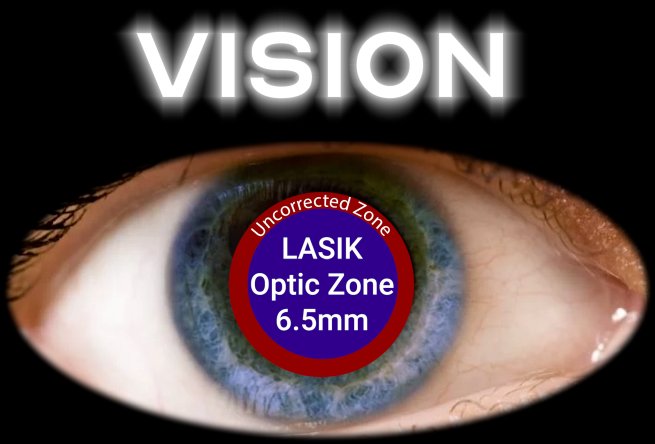
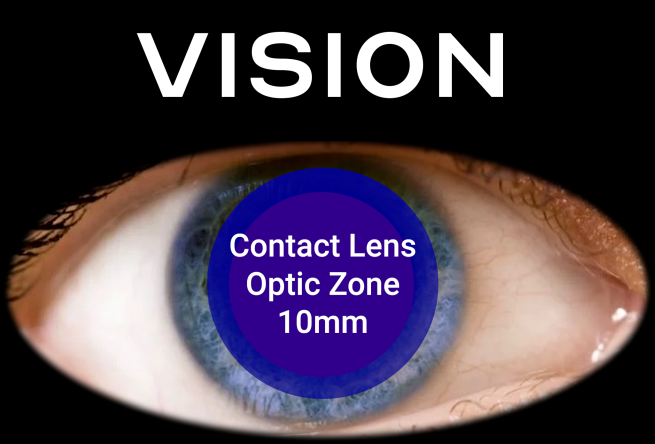
LASIK permanently shrinks the optical zone of your cornea. At night your pupils dilate beyond that treated zone, so light spills over the edge of the ablation—even if the eye still reads 20/20 on a chart.
Shrinking the Window You See Through
- Healthy night pupils commonly open to 7–9 mm.
- LASIK optical zones are typically 5.5–6.5 mm—often smaller in real-world outcomes after fully healing.
- The mismatch creates halos, glare, starbursts, and reduced contrast that glasses can’t correct.
- Once ablated, the larger natural optical zone can never be restored.
Dig deeper in the Suggested Reading guide, including expert commentary and measurements.
Slide to compare the full optical zone you have before LASIK with the reduced zone after surgery.
After reviewing the evidence
After reading this, where do you stand on LASIK?
Choose the answer that best describes your plans now.
We measure the selected option and survey placement. No name, email, or sign-up is requested.
Answer submitted
Your answer has been recorded.
Keep scrolling to review more evidence before making your decision.
Private decision check
Are you ready to make an informed choice?
Answer seven questions. Nothing is submitted or stored.
Keep the seller out of the decision
Why a LASIK consultation is not an independent opinion
A clinic is paid when a prospective patient says yes. Asking the clinic to estimate its own complication rate does not remove that conflict, and clinic-provided claims may use definitions or data you cannot independently audit.
You do not need a LASIK consultation to choose no surgery.
LASIK is elective. Keeping glasses—or using contact lenses when medically appropriate—avoids permanently reshaping the cornea. If you want personalized medical advice, seek it outside the refractive-surgery referral chain.
- The clinic has a direct financial interest in moving you from consultation to surgery.
- Testimonials and clinic-reported percentages are not substitutes for published, independently reviewable evidence.
- The FDA warns that even carefully screened patients treated by skilled surgeons can experience serious complications.
- Reading 20/20 on an eye chart does not measure dry eye, glare, halos, starbursts, ghosting, or night-driving difficulty.
- A consultation can create urgency and commitment around a procedure that is elective.
- Glasses and medically appropriate contact lenses correct vision without surgically removing corneal tissue.
Verify it yourself
Read the primary sources
Read the warning sections directly. Some FDA pages later pivot to choosing a surgeon or preparing for surgery; those sections should not be mistaken for independent evidence that surgery is necessary or safe for you.
- FDA LASIK Surgery ChecklistRead the poor-candidate and risk warnings at the top; later sections promote surgeon selection and surgical logistics
- FDA: LASIK RisksPossible vision loss, visual symptoms, chronic dry eye, and unknown long-term safety
- FDA: When LASIK Is Not for MeCandidacy concerns and precautions
- FDA PROWL Study ResultsNew visual symptoms and dry eye reported after LASIK
After reviewing the evidence
After reading this, where do you stand on LASIK?
Choose the answer that best describes your plans now.
We measure the selected option and survey placement. No name, email, or sign-up is requested.
Answer submitted
Your answer has been recorded.
Explore more evidence and patient resources across our website.
The safest deadline is no deadline.
Keep this guide and review the evidence away from a sales setting. If you want personalized medical advice, choose a clinician who neither performs nor refers patients for refractive surgery.
This page provides general educational information and is not medical advice. Discuss your individual health and treatment options with a qualified professional.